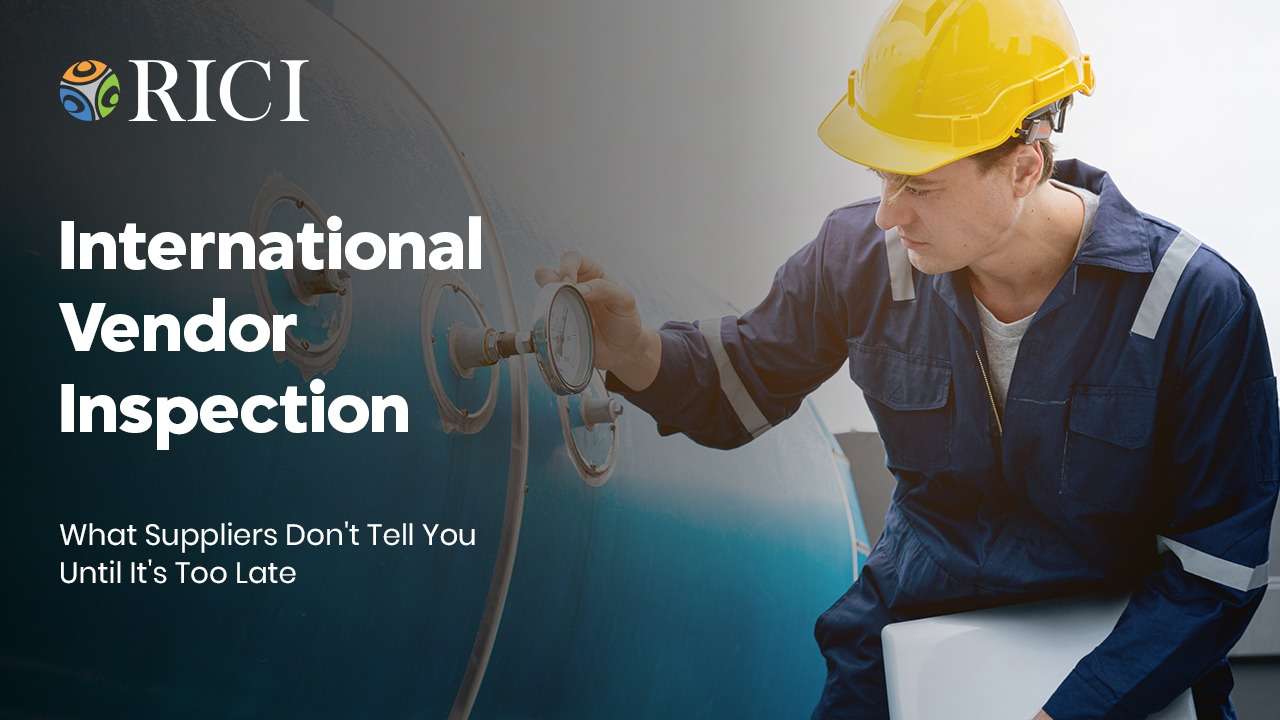
International Vendor Inspection: What Suppliers Don't Tell You Until It's Too Late
18-Jun-2026
International Vendor Inspection: What Suppliers Don't Tell You Until It's Too Late
International procurement offers significant advantages. Companies gain access to competitive pricing, broader supplier networks, and increased manufacturing capacity. However, once equipment is being fabricated thousands of kilometers away, visibility becomes one of the biggest challenges facing procurement and project teams.
There is a moment that almost every procurement team eventually experiences. The supplier reports that production is nearly complete, shipment deadlines are approaching, and clients are requesting updates. Then an uncomfortable question arises: does anyone actually know what is happening inside the supplier's workshop?
That is precisely why international vendor inspection has become an essential part of modern supply chain management.
At RICI Company Limited, we provide international vendor inspection services that help clients monitor quality, verify compliance, and maintain control over overseas manufacturing activities before equipment is shipped. Because while resolving issues before shipment can be challenging, correcting them after delivery is significantly more expensive and disruptive.
What Is International Vendor Inspection?
International vendor inspection is far more than a site visit or a review of supplier paperwork. It is a structured process that involves physically verifying that manufacturing activities, testing procedures, materials, and documentation comply with project specifications and contractual requirements before shipment approval is granted.
A comprehensive international vendor inspection may include:
-
Welding inspections
-
Dimensional verification
-
Material traceability checks
-
Coating inspections
-
NDT witnessing
-
Hydrotest witnessing
-
Positive Material Identification (PMI)
-
Factory Acceptance Test (FAT) witnessing
-
Production monitoring
-
Final release inspections
-
Documentation review
The objective is straightforward: ensure that clients receive exactly what was ordered, not simply what was promised.
The Biggest Challenge in International Procurement
Distance changes everything.
When suppliers are located overseas, even minor issues can remain hidden for extended periods. Production delays may not be reported immediately, documentation deficiencies can go unnoticed, material substitutions may occur without approval, and testing activities are sometimes postponed without proper communication.
By the time equipment reaches the project site, organizations may already be facing:
-
Manufacturing defects
-
Missing certifications
-
Incorrect materials
-
Failed inspections
-
Installation delays
-
Rework costs
-
Schedule overruns
Once equipment has passed through ports, customs clearance processes, and international logistics channels, resolving these issues becomes significantly more costly.
International vendor inspection reduces these risks by providing direct oversight throughout the manufacturing process.
What Independent Inspectors Actually Verify
Manufacturing practices vary considerably across different countries and facilities. Some suppliers operate highly controlled production environments with excellent quality systems and traceability procedures. Others may rely on reactive processes that only improve when inspections are scheduled.
This is why independent third-party inspection remains critical.
Our inspectors verify:
-
Actual production progress
-
Compliance with project specifications
-
Quality of fabrication and manufacturing work
-
Testing procedures and results
-
Material traceability
-
Documentation accuracy
-
Readiness for shipment
Rather than relying on assumptions, verbal updates, or optimistic production schedules, clients receive objective information about actual conditions inside the workshop.
International Vendor Inspection Is About More Than Finding Defects
One of the most common misconceptions about inspection is that its purpose is simply to identify non-conformances.
In reality, the greatest value of international vendor inspection comes from identifying risks early enough for corrective action to be taken before project schedules are affected.
Effective inspection requires more than technical expertise. It demands a combination of:
-
Technical knowledge
-
Communication skills
-
Understanding of manufacturing workflows
-
Familiarity with international standards
-
Professional coordination between suppliers and clients
The most successful inspections are often those where potential issues are resolved long before they become major project concerns.
Our International Vendor Inspection Services
RICI supports international vendor inspections for industrial equipment, manufacturing facilities, and fabrication projects across multiple sectors.
Our services include:
-
Manufacturing surveillance
-
Welding and fabrication inspections
-
Coating and painting inspections
-
Mechanical inspections
-
FAT witnessing
-
NDT witnessing
-
Material verification
-
Dimensional inspections
-
Documentation review
-
Pre-shipment inspections
-
Final release verification
We routinely inspect equipment such as:
-
Pressure vessels
-
Piping systems
-
Structural steel
-
Heat exchangers
-
Valves
-
Storage tanks
-
Electrical systems
-
Instrumentation packages
-
Rotating equipment
-
Industrial skids and modules
Throughout manufacturing and testing activities, our reporting provides clients with accurate, practical, and transparent updates that support informed decision-making.
Industries We Serve
Our international vendor inspection services support organizations across a wide range of industries, including:
-
Oil & Gas
-
Petrochemical
-
Energy & Utilities
-
Power Generation
-
Water & Desalination
-
Industrial Manufacturing
-
Infrastructure Projects
-
EPC Contractors
Regardless of whether a supplier is local, regional, or overseas, the objective remains the same: protecting quality before shipment approval takes place.
Why Companies Choose RICI for International Vendor Inspection
International procurement already introduces enough uncertainty into a project. Organizations require inspection partners who understand not only technical compliance requirements but also the realities of manufacturing environments.
Clients work with RICI because we provide:
-
Experienced inspection personnel
-
Expertise in international standards
-
Independent third-party verification
-
Accurate and detailed reporting
-
Fast coordination and response
-
Practical field experience
-
Professional communication with suppliers and clients
Most importantly, we understand that inspection should never slow projects down unnecessarily. Its purpose is to prevent larger and more expensive problems from emerging later.
Final Thoughts
International vendor inspection is ultimately about confidence.
Confidence that materials conform to specifications. Confidence that testing has been performed correctly. Confidence that fabrication meets project requirements. Confidence that shipment approval is justified.
Without proper inspection, organizations are often relying solely on supplier assurances. With professional international vendor inspection services, they gain visibility, accountability, and control throughout the manufacturing process.
For major industrial projects, that visibility can protect schedules, budgets, and operational reliability long before equipment ever reaches the project site.
Need Professional International Vendor Inspection Services?
If you require reliable international vendor inspection services for overseas suppliers, fabrication facilities, or manufacturing projects, RICI Company Limited is ready to help.
Our inspection team provides practical, technically focused, and independent quality assurance services that help organizations maintain control across global supply chains while reducing procurement and project risk.
Related Blogs


Get Certified with International Standards
If your organization is looking to get certified for international standards relevant to your business, we can assess and assist you. ✅
Send Your Inquiry